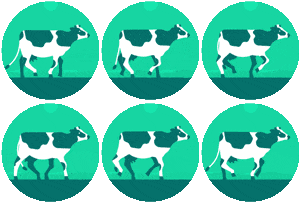


Black and White Cows: How to Identify Them


Despite quite a few romanticized images of black and white cows grazing around the countryside, this colour combination is very rare in cattle.
Black and white cow breeds are the most popular variety of cows. Some of the best breeds among the black and white cows are Holstein, other than this there are a total of 15 breeds of black and white cattle. They are easy to recognize due to the black and red markings on the white base.
How to identify black and white cows?
Identifying the black and white cow breeds can be a daunting task. There are already many varieties of black and white cows. Some of the most popular ones are Holstein Friesian Cattle having black or red spotting over the body. They are a high milk-producing breed with less feed.
Next comes the Lakenvelder which is popularly known as Dutch belted cattle because stripes on their body give them belted appearance. Another black and white cow breed is Belted Galloway, they are similar to Lakenvelder but can stand cold better than many other breeds because they have a doable coating of hair on the body. Texas Longhorns are easily identifiable due to their longhorns and colour patterns. They are the most intelligent among black and white cow breeds.
German Black Pied are smaller-sized cows but the most fertile ones. It is hard to differentiate between the Holstein and German black pied. They retain the milk production characteristics of their ancestors.
Read this also: Complete information about expenses and earnings on HF Cow
How to maintain black and white cows?
Maintaining a black and white cow can be similar to maintaining other breeds. They generally fall into the category of domestic cattle.
Vaccination and feeding are the basics of the maintenance of black and white cows. Then comes the regular medical checkups to keep track of the cattle’s health. Whether it is a black and white cow-calf or an adult, they are happy when kept in a group and not alone.
If you notice any sudden behaviour change, do contact a vet, it can be the starting of any of the common diseases. Some of the diseases that commonly affect the cow are detailed below.
How to Purchase a black and white cow?
If you wish to purchase a black and white cow, then take out your phone go to the play store, and download the “Animall” application. Register yourself by verifying your mobile number and then select the cow option where you will find different breeds of cows. Then filter black and white breed, milk capacity, and calving, and then select the best cow you want to bring home from the options available.
Bring home a black and white cow by following these 3 easy steps.
Enter your village or district name or Pincode.
After entering the Pincode, select the cow section. Here choose the breed black and white and select the milk capacity and calving as per your preference.
Now you will start seeing all the cows around you. You can select any cow of your choice.
Read this also: How to identify good milch buffaloes.
How to list my black and white cow for sale?
If you want to sell a black and white cow then you can do it on the “Animall” application. First, you need to register yourself and then go to Sell Animals. After that, enter the milk capacity, rate, and price of your black and white cow. Once you are done filling in all the required detail, your cow will be registered on the “Animall” app. Any buyer who is interested in purchasing your cow can call you directly.
Apart from selling and purchasing cattle, you can also get all the information related to the cattle on our app. If your cow is not keeping well, you can talk to doctors directly through our app. You can get the best quality and verified cattle at affordable rates and that too without paying any commission.
Read this also: Know when silage becomes the enemy of animal productivity. Silage
Diseases that commonly affect black and white cows and their treatment
Diseases that commonly affect black and white cows are:-
Many diseases can cause serious illnesses to your cow.
Digestive system disease
Diseases related to the digestive system like simple indigestion, saline indigestion, acidic indigestion, constipation, bloody diarrhoea, and acidity.
Treatment of simple indigestion:
- Feed them spices which will help them to increase their hunger.
- Provide them feed which digests easily.
Treatment of saline indigestion:
- During the preliminary stage of the disease, give light acid such as 5% acetic acid @5-10ml per animal weight or approx 750ml vinegar to cure the disease.
- If a brain stroke is occurring and nothing can be seen after giving medicine 2-3 times, then the doctor should do the rumenotomy operation.
Treatment of acidic indigestion:
- Avoid feeding acidic fodder to animals.
- During the start of this disease, feed animals saline elements like baking soda and medicines which will help to energize their liver.
Treatment of constipation:
- For heavy animals, the scrape of ginger powder@30gm and solution of Magnesium sulphate@800gm is given to animals through the mouth.
- In the initial stage give them flax oil@500 ml and don’t let them have dry fodder as a feed and give them more water.
Treatment of bloody diarrhoea:
- Give sulpha medicines through vaccinations or mouth and along with that give more amount of water and glucose@5%.
- Sulpha medicines, antibiotics, opiates, iron elements, or tennoform can also be given to get rid of diarrhoea.
Treatment of acidity:
- If this disease is seen repeatedly in animals then activated charcoal, Dettol water, and 40% formalin@15-30 ml should be given.
- Turpentine oil@30-60ml, extract of mustard/flax oil @500ml or asafoetida (heeng)@60ml is given to animals (don’t let them consume too much turpentine oil, this can lead to stomach issues).
- Look at the condition and type of disease of the animal, and consult the vet through our app.
Jaundice
Types of Jaundice:
- Jaundice because of closure of lymph nerves
- poisonous jaundice or Intrahepatic – due to liver disease
- Hemolytic jaundice or Pre hepatic – due to destruction of red blood cells.
Treatment of Jaundice :
- First, you need to find out the cause of poisonous jaundice.
- The animals that have blood pest diseases and infections, keep them away from other animals.
- Give salt solution, glucose, calcium gluconate solution, Vitamin A and C, and along with that give antibiotic medicines.
- Give animals liver tonic along with fatless and green fodder.
- During the deficiency of phosphorus, feed them sodium acid monophosphate.
Anaemia
The symptoms are depression, muscular weakness, anorexia, and increased heart rate. The disease is caused because of inadequate nutrients in the diet, poor nutrition management, and colostrum intake.
Treatment:
Vitamins A, B, and E are given in the diet, and an injection of iron dextrin @150mg can help in curing anaemia.
Lead poisoning
The calf is dull and usually sunken abdominal pain is the major symptom of lead poisoning. It usually occurs when they lick the painted tarpaulins, metalwork, lead batteries, etc.
Treatment:
A dose of calcium versenate @25% is given twice a day to cure lead poisoning in sub-acute cases.
Read this also: Such grain can become poison for animals
Enteritis/Calf scours/ Diarrhoea
In this disease first, the excessive loss of water occurs then acidosis and dehydration and then the animal dies. The disease mainly occurs due to drinking unclean water, unclean hygiene conditions, and poor feeding systems.
Treatment: proper ventilation and dry bedding are required.
Black and white cow prices
are generally high. As they are some of the most productive breeds. From the above description, one can easily identify the different breeds of black and white cows.
Read this also: Know what should and should not be fed to animals during monsoon.